
Selecting Resilient Grass Types and Soil Preparation
Building a resilient, vibrant yard starts with understanding what grows best in our unique corner of New England. Rhode Island’s coastal climate brings high humidity in the summer, biting maritime winds in the winter, and variable soil structures ranging from sandy coastal loam to heavy glacial till. Selecting the right turf species and balancing soil chemistry creates a self-sustaining lawn that naturally resists pests, tolerates summer heat, and requires minimal chemical inputs.
Choosing Turfgrass Varieties for Lawn Care in Rhode Island
Because Rhode Island sits squarely in the cool-season grass zone, choosing varieties bred for local conditions makes all the difference. Cool-season grasses experience their primary growth spurts during the moderate temperatures of spring and autumn, slowing down during the dog days of July and August.
- Fine Fescues (Creeping Red, Chewings, Hard, and Sheep Fescue): Fine fescues are top performers across Rhode Island. They boast exceptional shade tolerance, thrive in low-fertility soils, and demand significantly less water and fertilizer than other species. If you want a lower-maintenance lawn that stays green under mature oak and pine canopies, fine fescue blends are an outstanding choice.
- Tall Fescue (Turf-Type): Modern turf-type tall fescues develop deep, extensive root systems that reach deep into the subsoil for moisture. This makes tall fescue the most drought-tolerant cool-season turfgrass available for Rhode Island homes. It stands up remarkably well to heavy foot traffic, summer heat waves, and sandy coastal soils.
- Kentucky Bluegrass: Known for its rich, emerald-green color and soft texture, Kentucky bluegrass spreads via underground stems called rhizomes, allowing it to recover quickly from minor damage. However, it requires more water, higher fertility levels, and full sun exposure to thrive. We often recommend blending Kentucky bluegrass with fine and tall fescues to combine visual appeal with drought resistance.
- Perennial Ryegrass: Valued for rapid germination and fast establishment, perennial ryegrass is great for overseeding worn patches. It offers excellent wear tolerance but requires consistent moisture and is susceptible to winter desiccation along exposed coastal bluffs.
If your lawn has degraded into a patch of weeds, bare dirt, or thinning turf, starting fresh with a custom seed blend tailored to your property’s sun and soil conditions can transform your outdoor living space. Reviewing professional lawn renovation guidelines can help you determine whether your property needs an overseeding touch-up or a complete turf overhaul.
Soil Testing and pH Balance
Even the best grass seed cannot flourish in poor, acidic, or nutrient-starved soil. In Rhode Island, native soils tend to be naturally acidic, often dipping below a pH of 5.5 due to granite bedrock and pine needle accumulation.
For turfgrass to absorb essential nutrients like nitrogen, phosphorus, and potassium, you should maintain a soil pH between 6.0 and 7.0. When soil pH drops below 6.0, applied fertilizers become chemically locked in the soil, preventing turf roots from absorbing them. This wastes your money and increases the risk of nutrient runoff into local waterways.
A professional laboratory soil test reveals your soil’s exact pH level and nutrient concentrations. Test your lawn every two to three years in early spring or late summer. If the test indicates acidic soil, applying agricultural ground limestone gradually raises the pH to the optimal 6.0 to 7.0 range.
When establishing a new lawn or renovating an existing one, organic matter content should range from 3% to preferably 5%. Incorporating well-aged compost into the top four to six inches improves soil structure, enhances moisture retention in sandy soils, improves drainage in heavy clay, and provides a continuous, slow-release source of natural plant nutrition.
| Grass Type | Ideal Sun Exposure | Drought Tolerance | Fertilizer Requirement | Optimal Soil pH |
|---|---|---|---|---|
| Fine Fescues | Partial Shade to Full Sun | High | Low (1–2 lbs N/1,000 sq ft/yr) | 5.5 – 6.5 |
| Tall Fescue | Full Sun to Partial Shade | Very High | Moderate (2–3 lbs N/1,000 sq ft/yr) | 5.8 – 7.0 |
| Kentucky Bluegrass | Full Sun | Moderate | High (2–4 lbs N/1,000 sq ft/yr) | 6.0 – 7.2 |
| Perennial Ryegrass | Full Sun to Light Shade | Moderate | Moderate (2–3 lbs N/1,000 sq ft/yr) | 6.0 – 7.0 |
Essential Strategies for Sustainable Lawn Care in Rhode Island
A lush, healthy lawn does not require complicated chemical schedules. Practicing sound cultural habits—proper mowing, mindful watering, and seasonal aeration—builds deep, resilient root systems that naturally out-compete weeds and withstand summer heat.
Mowing at heights between 2 and 3 inches is best to encourage deeper roots, discourage weeds, and reduce evaporation. Taller grass blades cast shade over the soil surface, preventing sunlight from reaching buried weed seeds like crabgrass and dandelion. Taller turf also insulates root systems against summer heat and reduces soil moisture evaporation.
Keep your mower blades sharp. Dull blades tear and shred grass tips rather than slicing them cleanly. Frayed, jagged leaf tips turn brown, lose moisture rapidly, and create open wounds that invite fungal pathogens like dollar spot and red thread. Sharpen your mower blades every 20 to 25 hours of mowing time.
Always follow the “one-third rule”: never remove more than one-third of the total grass blade height in a single mowing session. Cutting off too much blade at once shocks the plant, forcing it to consume root energy reserves to regrow foliage.
Leave your grass clippings on the lawn whenever possible. Using a mulching mower returns finely chopped clippings directly to the soil, where they break down within days. Clippings can supply up to 25% of your lawn’s annual slow-release nitrogen needs—serving as nature’s own free fertilizer without adding to thatch buildup. For a simple seasonal checklist on keeping your turf manicured, explore this efficient lawn maintenance routine.
Watering Practices and Irrigation Limits
Overwatering is one of the most common and damaging lawn mistakes in the Ocean State. Excess moisture encourages shallow root systems, promotes fungal diseases, leaches valuable nutrients past the root zone, and wastes municipal water.
Do not exceed a total of 1 inch of water per week, including rainfall amounts. Use a simple rain gauge or place an empty tuna can on your lawn during an irrigation cycle to measure water output.
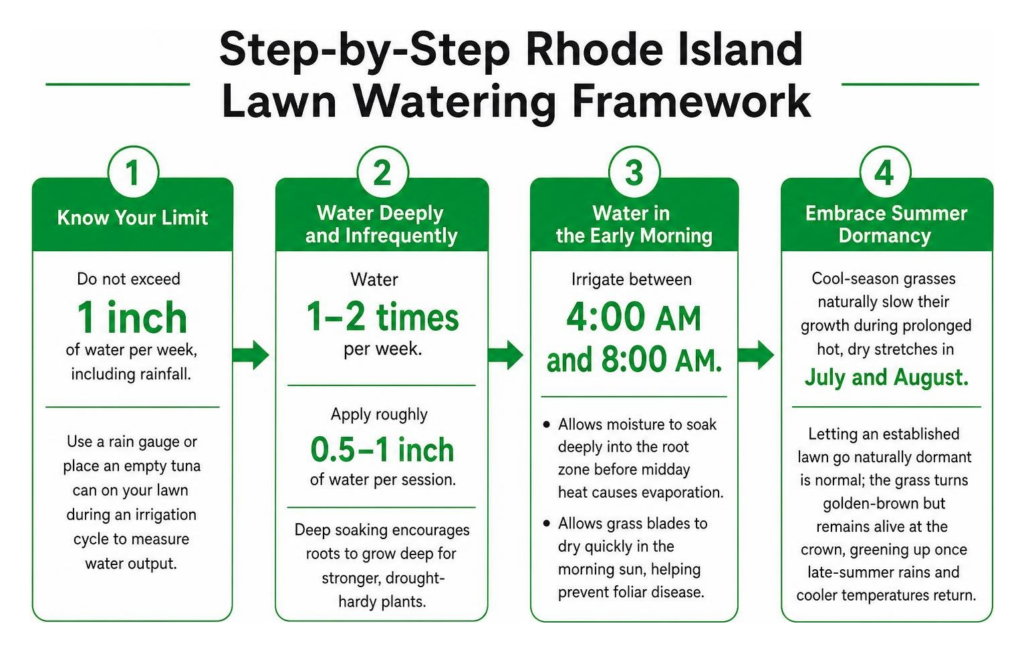
- Water deeply and infrequently: Instead of running sprinklers for 10 minutes every day, water once or twice a week with roughly 0.5 to 1 inch of water per session. Deep soaking encourages grass roots to dig down into the soil in search of moisture, creating drought-hardy plants.
- Time it for early morning: The best time to irrigate is between 4:00 AM and 8:00 AM. Morning watering allows moisture to soak deeply into the root zone before midday heat causes evaporation, and allows grass blades to dry quickly in the morning sun, preventing foliar disease.
- Embrace summer dormancy: Cool-season grasses naturally slow their growth during prolonged hot, dry stretches in July and August. Letting an established lawn go naturally dormant is completely normal; the grass turns golden-brown but remains alive at the crown, greening up once late-summer rains and cooler temperatures return.
Aeration and Thatch Management
Over time, foot traffic, lawn equipment, and natural settling compact Rhode Island soils, squeezing out tiny air pockets that roots need to breathe and absorb moisture. At the same time, dead grass roots, stems, and organic debris can accumulate at the soil surface, forming a dense layer known as thatch.
A thin thatch layer (under half an inch) acts as a helpful organic mulch. However, when thatch exceeds 1 inch, it forms a water-repellent barrier that prevents moisture, air, and nutrients from reaching the soil, while creating a breeding ground for insects and fungal diseases.
Early autumn is the ideal window for core aeration and dethatching in Rhode Island. Core aerators pull small plugs of soil and thatch (roughly 2 to 3 inches deep) out of the turf, relieving soil compaction and opening direct channels for oxygen, water, and nutrients.
Following up aeration with a seasonal cleanup and overseeding fills bare spots and thickens turf density ahead of winter. If your yard has accumulated fallen branches, excessive leaf litter, or compacted thatch over the season, taking time for a thorough seasonal yard clean up will set up your lawn for spring vitality.
Responsible Fertilization and Coastal Water Protection
Fertilization plays an important role in turf density and root strength, but in a coastal state like Rhode Island, every fertilizer application carries environmental responsibility. Narragansett Bay, our coastal salt ponds, and our freshwater rivers are sensitive to nutrient pollution. Excess nitrogen and phosphorus running off residential lawns fuel toxic algal blooms, deplete dissolved oxygen levels, and harm local marine life.
Practicing responsible feeding means applying the right nutrients at the right time, in the right amounts. If you are satisfied with how your lawn looks, you may choose not to fertilize at all—skipping fertilizer is the ultimate low-maintenance, ocean-friendly approach.
When feeding is needed, apply a maximum of 2 pounds of nitrogen per 1,000 square feet per year on an established lawn 10 years old or older. Younger lawns with developing root systems should receive no more than 3 pounds of nitrogen per 1,000 square feet annually.
- Prioritize slow-release formulations: Choose fertilizers that contain at least 50% slow-release or water-insoluble nitrogen (WIN). Slow-release products feed the turf steadily over several weeks, promoting uniform root growth while dramatically reducing the risk of nutrient leaching into groundwater.
- Time applications for late summer and early fall: The single most beneficial feeding window in Rhode Island occurs between late August and late September. During this time, cooler air temperatures and warm soil encourage turfgrass to expand its root reserves and recover from summer stress.
- Observe the fall cutoff date: Never apply nitrogen fertilizers after October 15. As winter approaches, grass roots stop taking up nutrients, leaving late-applied fertilizer vulnerable to washing directly into storm drains during winter rains and snowmelt. Never apply fertilizer to frozen or waterlogged ground.
- Avoid mid-summer feeding: Applying nitrogen during the intense heat of July and August stresses cool-season grass, forcing leaf growth when the plant wants to conserve energy, while encouraging fungal outbreaks and feeding opportunistic weeds.
If you are dealing with an overgrown or neglected yard, combining measured nutrient feeding with a structured cleanup plan works wonders. Following clear, comprehensive yard transformation steps makes it easy to bring tired turf back to life.
Phosphorus Management and Buffer Strips
Phosphorus is an essential plant nutrient for root development and seed germination, but established Rhode Island soils typically contain ample native phosphorus to sustain mature turfgrass. When excess phosphorus washes into fresh lakes, ponds, and rivers, it triggers massive blooms of blue-green algae that choke out aquatic species.
- Use phosphorus-free fertilizers: For established lawns, always choose zero-phosphorus fertilizer blends (indicated by a “0” as the middle number on the N-P-K fertilizer bag, such as 24-0-10).
- Test before adding phosphorus: Only apply phosphorus fertilizers if a recent laboratory soil test explicitly confirms a nutrient deficiency, or when establishing a brand-new lawn from bare soil.
- Maintain clean hardscapes: Always sweep or blow stray fertilizer granules off sidewalks, driveways, patios, and curbs back onto the grass. Granules left on paved surfaces wash directly into municipal storm sewers during the next rainstorm.
- Establish protective buffer strips: Leave a buffer strip of at least 25 feet of unfertilized grasses or native vegetation around water bodies, including streams, ponds, wetlands, coastal shorelines, and drainage swales. These vegetative buffers capture and filter runoff before it reaches sensitive aquatic habitats.
Integrated Pest Management for Lawn Care in Rhode Island
Integrated Pest Management (IPM) is an ecological approach to lawn health that focuses on long-term pest prevention through cultural practices, using chemical treatments only as a targeted, last resort.
- Accurate identification comes first: Before reaching for a pesticide, identify the specific weed, insect, or disease affecting your turf. Many lawn irregularities—such as localized dog urine burns or drought stress—mimic insect or fungal damage but require no chemical intervention.
- Spot-treat rather than blanket-spray: If a weed or insect issue arises, spot-treat only the affected patches rather than blanket-spraying your entire yard with broad-spectrum chemicals.
- Incorporate white clover: Consider blending white Dutch clover into your turfgrass seed mix. Clover naturally pulls nitrogen from the atmosphere and fixes it into the soil, providing free, continuous plant food. It stays green during summer dry spells, resists grubs, and flowers to support native pollinators.
- Encourage beneficial organisms: Healthy soil contains millions of beneficial microbes, earthworms, and predatory insects that keep common turf pests in check. Avoiding unnecessary broad-spectrum pesticides preserves these helpful natural predators.
Frequently Asked Questions About Rhode Island Lawn Maintenance
When is the optimal time to fertilize a lawn in Rhode Island?
The best window to fertilize a Rhode Island lawn is in late summer to early fall, specifically from late August through late September. During this period, cool-season grasses absorb nutrients to rebuild root systems exhausted by summer heat.
A light secondary application can be made in late spring (mid-May to early June) after the initial spring growth flush has tapered off. Avoid fertilizing before spring green-up, avoid mid-summer applications during heat waves, and never apply fertilizer after the October 15 seasonal cutoff date.
How much water does a Rhode Island lawn need per week?
Established Rhode Island lawns require a maximum of 1 inch of water per week, including natural rainfall. Delivering this moisture in one or two deep watering sessions per week promotes deep, resilient root growth.
During typical Rhode Island summers, natural rainfall often supplies all the water your lawn needs. You can track weekly precipitation with a simple rain gauge to avoid unnecessary irrigation.
Why is phosphorus fertilizer restricted for Rhode Island lawns?
Phosphorus is restricted because it is the primary nutrient responsible for harmful algal blooms in freshwater ponds, lakes, and coastal estuaries. Most mature Rhode Island soils naturally contain adequate phosphorus for established grass.
To protect local water resources like Narragansett Bay, homeowners should use phosphorus-free lawn fertilizers unless a certified soil test confirms a specific deficiency or you are planting brand-new turf.
Conclusion
Creating a thick, vibrant lawn in the Ocean State does not require heavy chemical applications or excessive watering. By selecting hardy cool-season grasses like fine and tall fescues, maintaining a balanced soil pH between 6.0 and 7.0, mowing high with sharp blades, and respecting our coastal watersheds with zero-phosphorus fertilizers and 25-foot buffer zones, you can cultivate an outdoor space that is both beautiful and environmentally responsible.
At Lawnscapes, we take immense pride in delivering top-tier outdoor solutions tailored to Rhode Island’s distinct coastal environment. Whether your property needs seasonal overseeding, core aeration, or complete turf restoration, our team provides the dedicated care and local expertise your landscape deserves. Reach out to us today to explore our premier lawn and landscape care and let us help you turn your yard into a lasting masterpiece.