
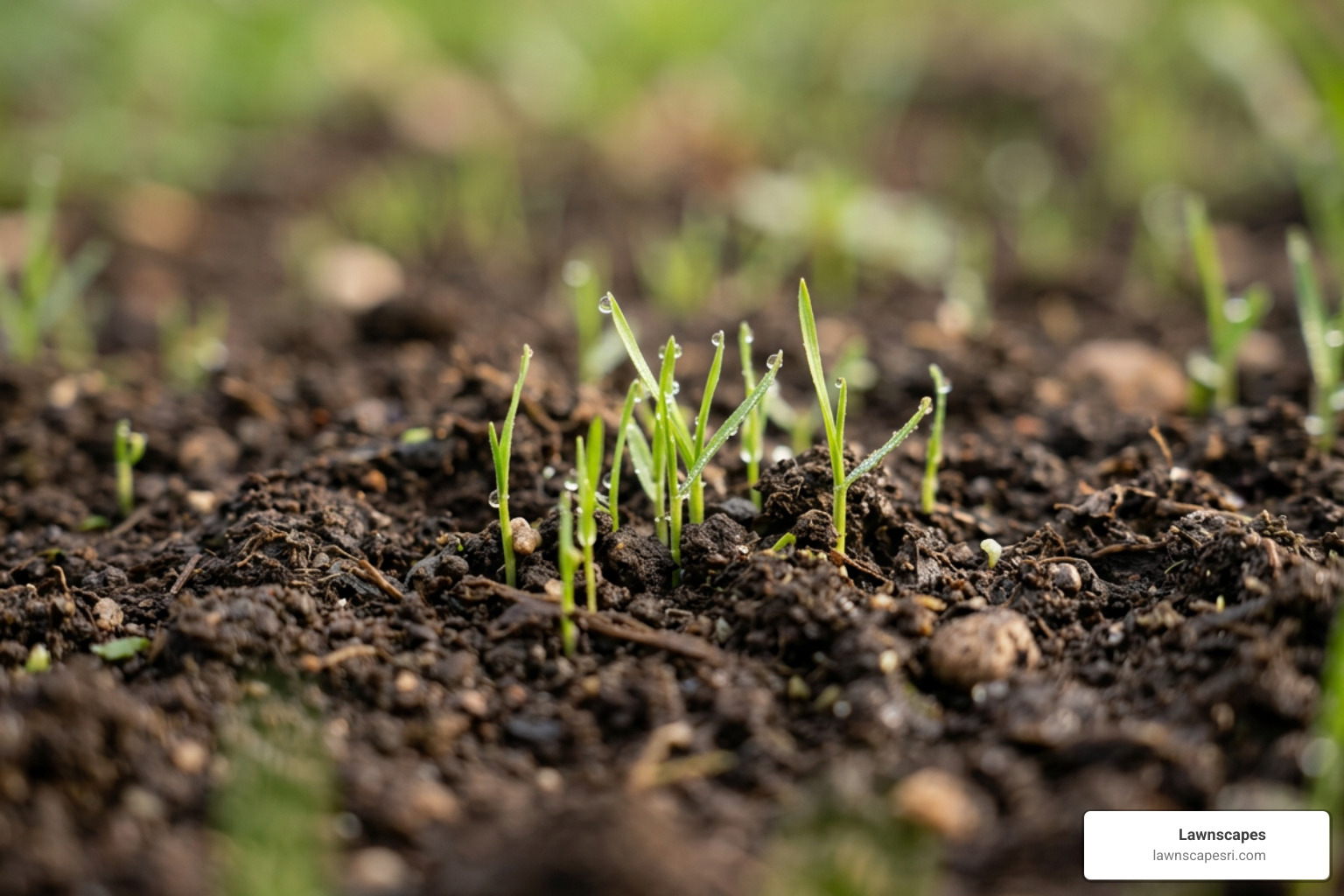
Why Aeration and Overseeding in Rhode Island Makes or Breaks Your Lawn
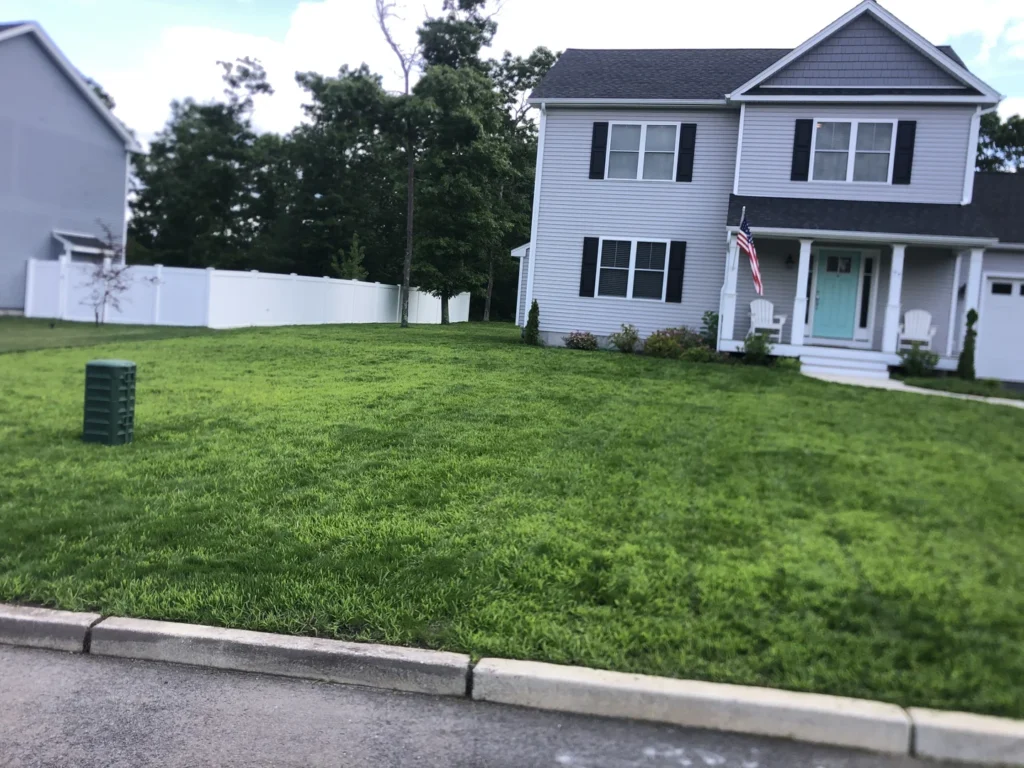
Aeration and overseeding in Rhode Island is one of the highest-impact things you can do for a tired, thin, or compacted lawn — and timing it correctly is everything.
Here’s a quick snapshot of what you need to know:
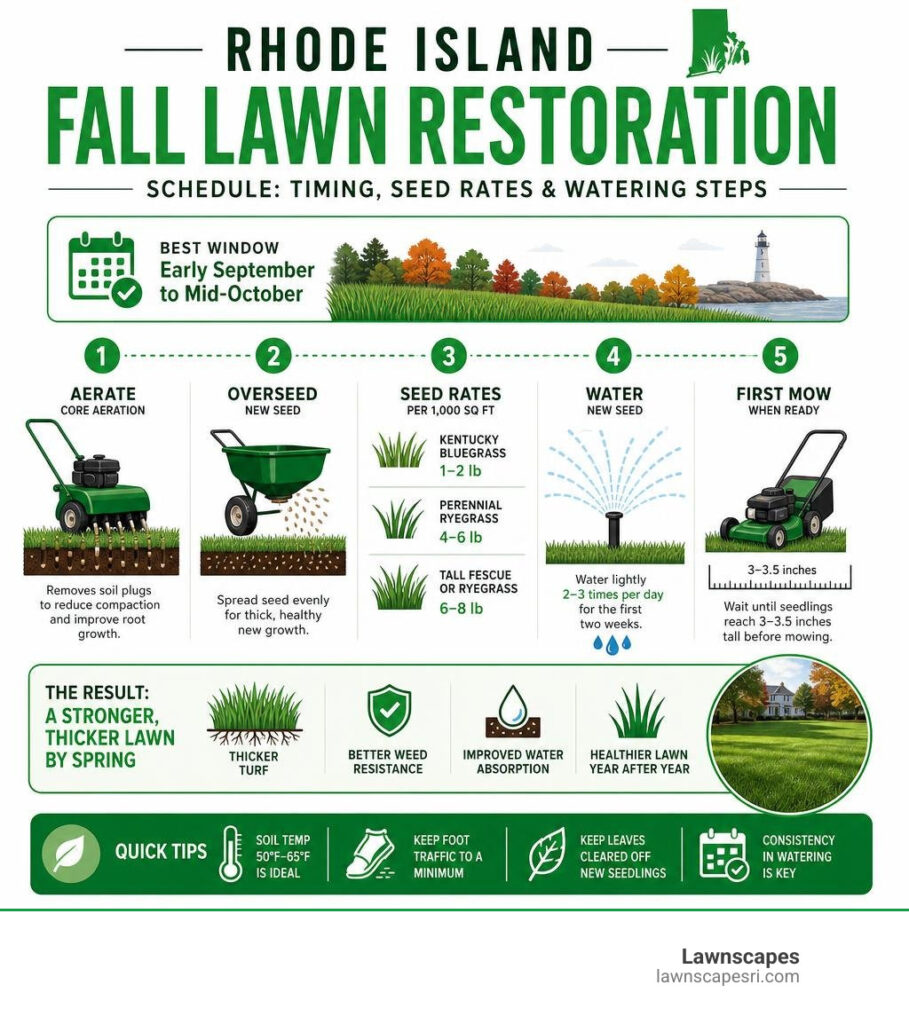
- Best window: Early September through mid-October
- Method: Core (plug) aeration only — not spike aeration
- Best grasses: Kentucky bluegrass, perennial ryegrass, tall fescue, fine fescue blends
- Seed rate: 1–2 lb/1,000 sq ft (Kentucky bluegrass) up to 6–8 lb/1,000 sq ft (tall fescue or ryegrass)
- After seeding: Water lightly 2–3 times per day for the first two weeks
- First mow: Wait until seedlings reach 3–3.5 inches tall
Rhode Island’s cool, humid summers leave lawns stressed, compacted, and thin by late August. Foot traffic, drought, and heat create bare patches that weeds are happy to fill — fast. Fall gives cool-season grasses their best chance to recover before winter sets in.
The good news: a straightforward fall renovation sequence can restore even heavily worn turf in a single season.
I’m Mark Trosin, and I’ve been working in the landscape industry since 1988, with decades of hands-on experience performing aeration and overseeding across Rhode Island and southern New England. In this guide, I’ll walk you through the exact process we use to get results.
Ideal Timing for Aeration Overseeding Rhode Island Turf
When it comes to performing aeration overseeding Rhode Island property owners often wonder why late summer and early autumn get all the glory. In the Ocean State, the ideal window opens in early September and runs through mid-October.
During this target period, Rhode Island’s daytime temperatures settle into a comfortable range, while the soil remains warm from the summer months—typically hovering right in the optimal 50°F to 65°F zone at a 2-inch depth. This warm soil accelerates seed germination, while cooler autumn air temperatures prevent tender new tender shoots from drying out under heat stress.
Another critical factor is root establishment. New grass seedlings require at least 4 to 6 weeks of active growing weather before the first hard frost arrives in late autumn. This gives young plants enough time to build deep, resilient root structures capable of surviving severe coastal winter freezing and thawing cycles. Furthermore, weed competition drops dramatically in September. Summer annuals like crabgrass reach the end of their life cycles and stop germinating, giving your fresh grass seed open turf space and access to sunlight, nutrients, and moisture.
For a detailed look at localized calendars, check out When to Overseed Your Lawn in Providence, RI.
Fall vs Spring Aeration Overseeding Rhode Island
While spring lawn care is popular among homeowners eager to get outside, attempting aeration overseeding Rhode Island lawns in the spring presents major hurdles:
- Aggressive Spring Weed Competition: Crabgrass and broadleaf weeds germinate vigorously as soil warms in April and May. If you apply a spring pre-emergent herbicide to stop crabgrass, it will also kill your fresh grass seed. If you skip the pre-emergent to save the grass, crabgrass will rapidly invade your fresh lawn.
- Immature Root Systems: Spring-seeded grass rarely develops deep roots before mid-summer. When July heat waves hit southern New England, these shallow roots collapse under heat and drought stress.
- Fall Weather Advantages: Fall provides ideal soil warmth, consistent moisture, and less weed competition. Grass roots expand rapidly through late autumn and resume vigor early the following spring, producing a dense turf before summer arrives.
For cool-season turf, fall renovation is undeniably the superior choice.
Core Aeration vs. Spike Aeration: Why Core Plug Extraction Wins
Not all aeration methods produce equal results. When preparing turf for overseeding, understanding the difference between core aeration and spike aeration is vital.
Core aerators (also known as plug aerators) utilize hollow metal tines that mechanically penetrate the turf to pull soil cores measuring 2 to 4 inches deep and 1/2 to 3/4 inches in diameter. These extracted soil plugs drop onto the lawn surface to break down naturally. By removing physical soil cylinders, core aeration instantly relieves compaction, opens breathing channels for oxygen, allows rainfall to reach the root zone, and creates perfect seed pockets.
Conversely, spike aerators use solid metal tines or spikes to punch holes in the dirt. Rather than removing soil, spikes drive dirt outward, packing it tighter around the hole boundaries. This actually increases localized soil compaction and fails to create the open channels required for successful seed-to-soil contact.
| Feature | Core (Plug) Aeration | Spike Aeration |
|---|---|---|
| Mechanism | Removes hollow soil plugs (2–4 inches deep) | Punches solid spikes into the soil |
| Compaction Impact | Relieves soil compaction across the root zone | Increases compaction around hole walls |
| Seed-to-Soil Contact | Creates deep, open channels for seeds to fall into | Creates narrow pockets that seal quickly |
| Water & Oxygen Flow | Dramatically improves deep water and oxygen flow | Offers short-term, superficial water entry |
| Lawn Health Result | Long-term root expansion and lawn density | Minimal turf improvement; potential soil crusting |
For heavily compacted coastal soils, double-pass core aeration—running the machine across the lawn in two perpendicular directions—delivers optimal root zone relief.
Preparing Your Lawn and Selecting Grass Seed Blends
Thorough prep work paves the way for strong seed establishment. Before starting equipment, conduct a soil test through a local agricultural extension or testing kit. Cool-season grasses thrive in a target soil pH range of 6.0 to 7.0. If your soil test indicates acidic soil—common throughout Rhode Island—applying agricultural lime will correct acidity and maximize nutrient uptake.
The day before core aerating:
- Mow the existing lawn lower than usual—down to 0.5 to 1.0 inch for heavy renovations, or 2.0 to 2.5 inches for routine maintenance. Lower mowing reduces shade from established grass blades, giving new seedlings direct sunlight.
- Dethatch if thatch layers exceed half an inch thick.
- Mark irrigation heads, invisible dog fences, and shallow utility lines to prevent damage from heavy aerating machinery.
- If soil is bone-dry and hard, water thoroughly 24 hours prior so aerator tines can extract deep 2- to 4-inch cores.
Matching the right grass species to your site conditions is equally essential. Rhode Island lawns feature cool-season blends designed for climate durability:
- Kentucky Bluegrass: Offers high aesthetic appeal and self-repairing rhizomes, but takes 14 to 21 days to germinate.
- Perennial Ryegrass: Establishes rapidly in 5 to 7 days, providing quick cover and excellent wear tolerance.
- Tall Fescue: Features deep root systems that tolerate summer heat and dry spells, germinating in 7 to 14 days.
- Fine Fescue Blends: Excel in shady areas under tree canopies and in low-input lawn zones.
Recommended Seeding Rates for Aeration Overseeding Rhode Island Lawns
Overseeding rates are generally half the seeding rate required for establishing a brand-new lawn on bare dirt. Spreading seed too heavily causes seedlings to compete against each other for space and water, leading to weak turf.
Here are the target application rates per 1,000 square feet for Rhode Island lawns:
- Kentucky Bluegrass: 1 to 2 lb per 1,000 sq ft
- Perennial Ryegrass: 6 to 8 lb per 1,000 sq ft
- Tall Fescue: 6 to 8 lb per 1,000 sq ft
- Fine Fescue Blends: 3 to 5 lb per 1,000 sq ft
- Mixed Cool-Season Lawn Blends: 5 to 10 lb per 1,000 sq ft (depending on dominant species)
If you’re unsure which seed blend fits your yard, explore our guide on Steps To Aerate And Overseed Rhode Island Lawns – Cultivating Flora or review our comprehensive Services page.
Step-by-Step Sequence for Aeration, Overseeding, and Fertilization
Executing tasks in the correct sequence determines whether seed establishes successfully or gets wasted. Aerating before seeding is non-negotiable. Aerating after spreading seed dislodges seed and buries it too deep inside dirt plugs.
Here is the precise step-by-step process we follow on job sites:
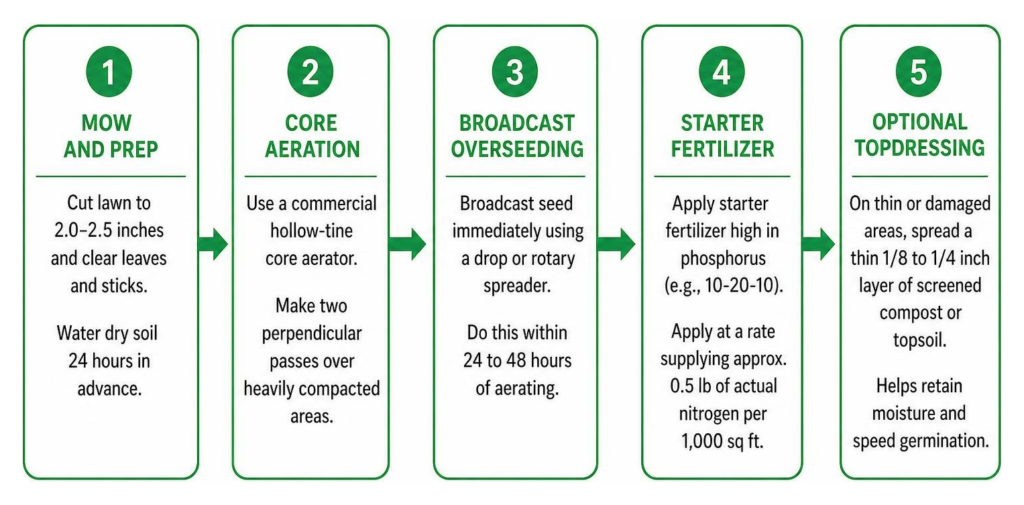
- Mow and Prep: Cut the lawn to a low height (2.0–2.5 inches) and clear off leaf debris and sticks. Water dry soil 24 hours in advance.
- Core Aeration: Pass over the lawn using a commercial hollow-tine core aerator. Make two perpendicular passes over heavily compacted areas to extract plenty of soil plugs.
- Broadcast Overseeding: Broadcast seed immediately using a drop or rotary spreader within 24 to 48 hours of aerating. Soil cores resettle quickly, so prompt seeding ensures seed drops deep into core holes for direct soil contact.
- Starter Fertilizer Application: Apply a starter fertilizer high in phosphorus (the middle NPK number, such as 10-20-10) at a rate supplying approximately 0.5 lb of actual nitrogen per 1,000 sq ft. Phosphorus stimulates early root development.
- Optional Topdressing: On severely damaged or thin spots, spread a thin 1/8 to 1/4 inch layer of screened compost or topsoil to retain moisture and accelerate germination.
- Skip Weed Killers: Do not apply pre-emergent or broadleaf post-emergent herbicides at this time. Standard pre-emergents block grass seed germination, while post-emergents injure tender young seedlings.
For more technical breakdowns on step sequencing, check out Fall Aeration and Overseeding Sequence – GreenTurf Lab.
Post-Overseeding Care: Irrigation, Mowing, and Patch Troubleshooting
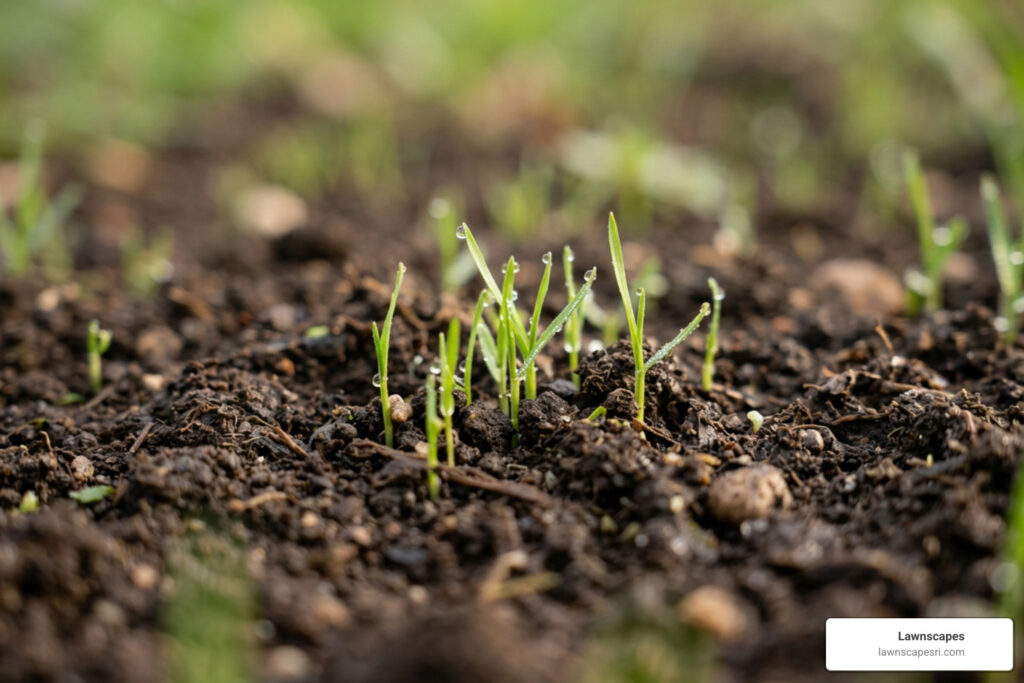
Proper post-care keeps seed moist during germination and allows new plants to build root systems.
Irrigation Schedule
Watering requires three distinct phases:
- Phase 1: Germination (Days 1–14): Keep the top 1/2 inch of soil consistently damp. Water lightly 2 to 3 times daily for 5 to 15 minutes per zone. Avoid puddling or water runoff that washes seeds away.
- Phase 2: Establishment (Weeks 3–4): As seedlings emerge, transition to deeper, less frequent watering—once daily or every other day for 20 to 30 minutes—to encourage roots to grow deeper into aeration holes.
- Phase 3: Maintenance (Weeks 5+): Shift to standard lawn irrigation: 1 inch of deep water per week delivered over 1 or 2 waterings.
Initial Mowing
Wait until new seedlings reach 3 to 3.5 inches tall before performing the first cut (typically 3 to 4 weeks after seeding). Ensure mower blades are sharp to cut cleanly without tearing or pulling delicate roots out of soft soil. Adjust mower deck height to remove no more than one-third of the grass blade length in a single pass.
Troubleshooting Patchy Germination
If patchy spots persist after 3 weeks:
- Verify that irrigation spray heads are reaching those zones evenly.
- Lightly rake uneven spots, apply a localized layer of topsoil, scatter extra seed blend, and keep moist.
- Ensure pets or foot traffic stay off seedling areas during early growth stages.
If managing seasonal lawn care feels overwhelming, our expert team provides full-service solutions via our Lawn and Landscape Care program.
Conclusion
At Lawnscapes, we believe every property in the Ocean State deserves a healthy, thick, deep-green lawn. Core aeration combined with overseeding is one of the single best cultural practices to relieve soil compaction, eliminate bare spots, improve drainage, and build turf density before winter sets in.
Whether you need seasonal core aeration, complete lawn renovation, or high-end turf care, our team delivers superior craftsmanship with an unwavering commitment to quality.
Ready to transform your lawn this season? Explore our full range of Services, or go directly to our contact us page to request your lawn evaluation today. Let us help you achieve a thick, vibrant lawn that stands out all year long!